 Nirajan Dahal
On a humid summer morning on St. Helena Island, South Carolina, fisherman Ed Atkins hauled a five-foot cast net from the water and shook loose a few glistening white shrimp. It’s a scene he has repeated for four decades, carrying forward a family business started by his parents in the 1950s.
These salt marshes are not just a workplace for Mr. Atkins – they are a way of life. They blur the boundary between land and sea and act as nurseries for countless marine species. They also hold deep cultural meaning for the Gullah Geechee people, whose traditions, language, and food are rooted in this coastal landscape.
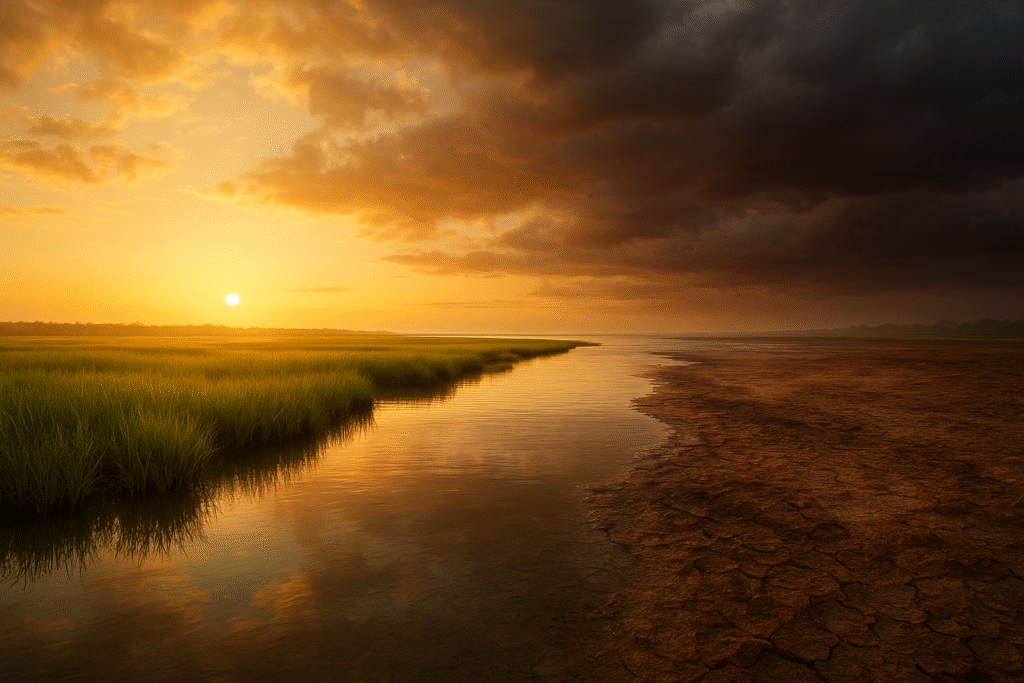
But scientists warn that these vast and seemingly timeless seascapes are among the most endangered places on Earth. A landmark study published in Science this week charts the cumulative human pressures on oceans worldwide – from climate change and overfishing to coastal development – and concludes that many marine ecosystems could soon be permanently transformed.
Marine ecologist Ben Halpern, one of the lead authors, describes the phenomenon as “death by a thousand cuts.” Each stressor – rising sea levels, ocean warming, acidification, and pollution – may seem small on its own, but together they are reshaping the ocean in ways that threaten biodiversity and coastal communities alike.
A Shrinking and Changing Ocean
The research team has been mapping human impacts since the early 2000s, when coral bleaching first drew widespread alarm. Their approach assigns “impact scores” to different habitats, including coral reefs, seagrass meadows, mangroves, and deep-sea floors. These scores reflect not just where human activities occur, but how vulnerable each habitat is to those pressures.
The findings are sobering:
- By 2050, about 3% of the global ocean could be altered beyond recognition.
- Nearshore waters – where most fishing and human activity takes place – are even more at risk, with more than 12% facing drastic change.
- Coastal ecosystems like salt marshes, mangrove forests, and intertidal zones are most threatened, even though they provide storm protection, carbon storage, and vital fish habitat.
Some nations, including Togo, Ghana, and Sri Lanka, face the highest risk because of their heavy reliance on ocean resources for food and livelihoods.
Dr. Halpern and colleagues caution that their projections may even be underestimates. They assume fishing activity remains steady rather than increasing and do not fully account for the impact of bycatch, habitat destruction from bottom trawling, or the rapid growth of seabed mining.
The overall trend, scientists agree, points toward a less diverse, less resilient ocean – one dominated by a smaller number of species able to withstand warming waters and other stressors.
Solutions Emerging from the Shoreline
Despite the grim outlook, communities are not standing still. Along the Southeast coast of the United States, efforts to protect and restore salt marshes are gaining momentum.
In South Carolina’s ACE Basin, a sprawling 350,000-acre estuary named for the Ashepoo, Combahee, and Edisto rivers, conservationists and volunteers are building “living shorelines” – structures made from oyster shells and native plants designed to reduce erosion, slow storm surge, and create habitat.
The results are encouraging: sediment is accumulating behind the oyster reefs, marsh grasses are taking root, and wildlife is returning. The initiative is part of a broader network spanning one million acres across four states, with partners ranging from local communities to the Department of Defense.
Culture on the Line
For Gullah Geechee leaders like Marquetta Goodwine, known as Queen Quet, saving the coast is inseparable from saving their culture. “You don’t have the marsh, you don’t have the Sea Islands,” she said. “And without the Sea Islands, you don’t have Gullah Geechee culture.”
Other traditions are also under pressure. At the annual Sweetgrass Festival in Mount Pleasant, South Carolina, master basket weaver Henrietta Snype displayed woven baskets made by five generations of her family. But she worries about the future – sweetgrass is harder to find, and access to gathering sites is increasingly restricted by coastal development.
“The times bring on a lot of change,” she said.
The Urgency of Now
Experts say waiting for perfect data before acting could be disastrous. The combined effects of warming, overfishing, sea level rise, and habitat loss could be greater than the sum of their parts, with some impacts amplifying others.
Initiatives like the global 30×30 pledge – a commitment to protect 30 percent of the world’s land and ocean by 2030 – could play a key role in preventing the worst outcomes. But they will require swift action and cooperation across governments, industries, and communities.
The future of the oceans, scientists say, will not just be measured in species lost or coastlines eroded – but in the resilience of the human cultures that depend on them. Whether the next generation inherits a thriving ocean or an impoverished one will depend on choices being made today.